How provider-owned, third-party and unresolved citation relationships appear across reconstructed recommendation contexts
Nalmert Research 003 · By Alexander Tatyanchenko.
This is a secondary association-level analysis of Nalmert Research 001, not a new AI measurement. We re-examined its existing citation evidence without changing the underlying observations or collecting new AI answers.
The finding — and the denominator that makes it meaningful
In the reconstructed recommendation-associated subset, 256 of 379 records were Provider-owned (67.55%), 102 were Third-party (26.91%), and 21 had an Unclear ownership relationship (5.54%). These 379 associations came from 267 unique citation rows.
67.55% does not mean that 67.55% of all AI citations are provider-owned. It is the share within 379 reconstructed recommendation-associated records. The analysis does not establish causation, source preference, or the editorial independence of third-party sources.
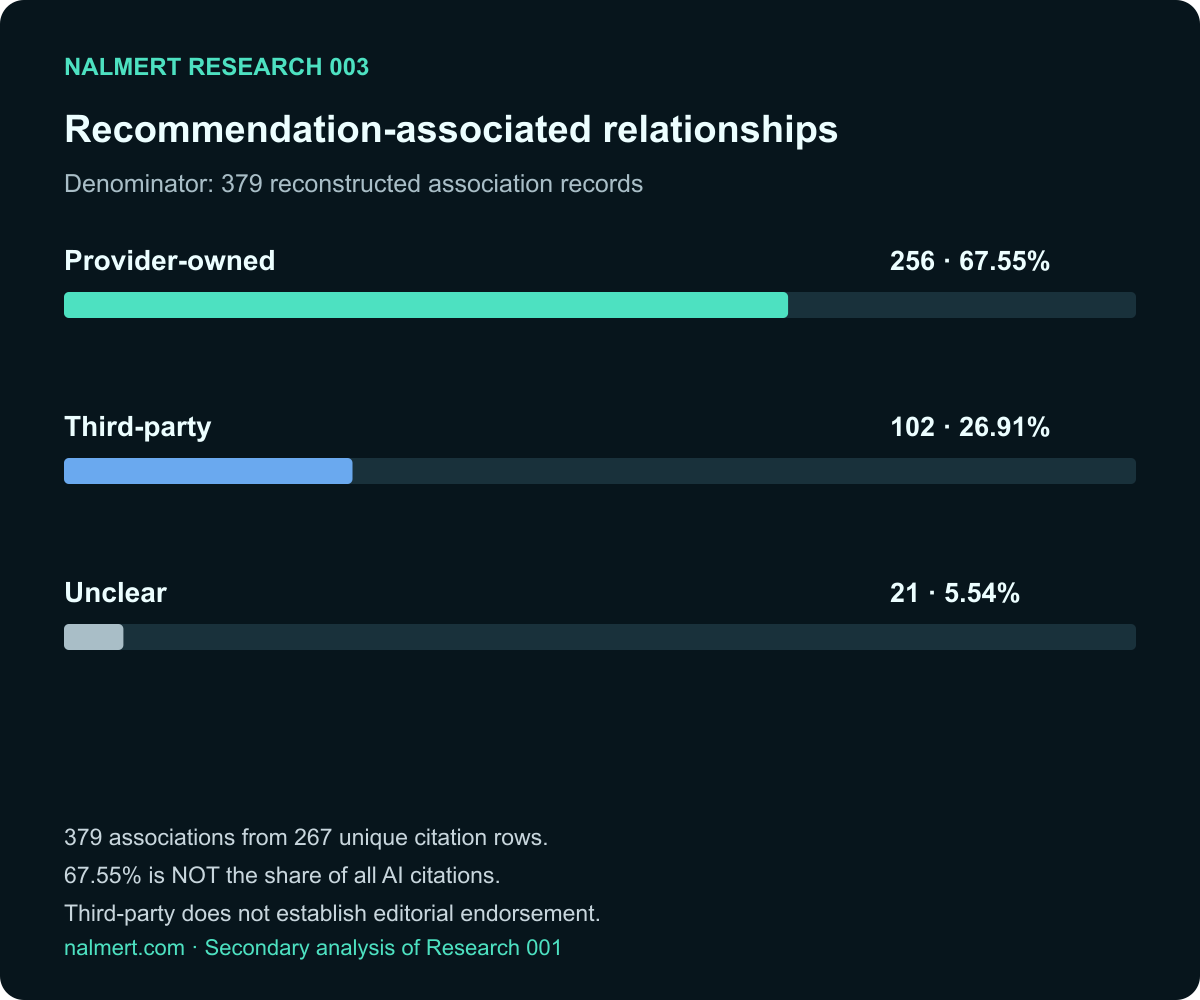
| Relationship | Count | Share |
|---|---|---|
| Provider-owned | 256 | 67.55% |
| Third-party | 102 | 26.91% |
| Unclear | 21 | 5.54% |
| Total | 379 | 100% |
What question does this audit answer?
Among reconstructable citation–provider associations linked to explicit AI recommendations, how often is the source provider-owned, third-party, or unresolved?
A citation URL alone cannot answer that question. A provider website can support a statement about its own company, a statement about another provider, or a general statement without a clear provider association. The role depends on the supporting fragment in the AI answer.
Three units that must not be confused
| Unit or analysis set | Count |
|---|---|
| Canonical citation rows (observation + URL) | 578 |
| Annotation records | 1,193 |
| Confirmed provider-associated records | 751 |
| Recommendation-associated records | 379 |
| Unique citation rows contributing to those 379 associations | 267 |
| General supporting records | 72 |
| Unresolved records without a confirmed provider | 370 |
A citation row identifies one observation–URL combination in the canonical dataset. An annotation record stores a reviewed linkage or its unresolved/general status. A citation–provider association links a citation URL to a specific provider and supporting fragment inside an observation. A single canonical row can produce zero, one, or several association records without duplicating the canonical source row.
The 1,193 annotation records are not 1,193 independent citations. Of these records, 751 have a confirmed provider association; 72 are general supporting records; and 370 lack a confirmed provider association. The primary set of 379 is a subset of the 751, not an additional group to be added to it.
The broader provider-associated subset
Among all 751 confirmed provider-associated records, 408 were Provider-owned (54.33%), 299 were Third-party (39.81%), and 44 had an Unclear relationship (5.86%). Here, “confirmed” refers to the provider association, not necessarily to confirmed ownership.

| Relationship | Count | Share |
|---|---|---|
| Provider-owned | 408 | 54.33% |
| Third-party | 299 | 39.81% |
| Unclear | 44 | 5.86% |
| Total | 751 | 100% |
The primary and secondary percentages describe overlapping, differently defined subsets. Their difference is descriptive; it is not evidence of a causal effect or a statistically independent comparison.
Source type is not ownership relationship
Source type describes the source ecosystem. Relationship describes whether that source belongs to the particular provider in the supporting fragment. A Provider website may therefore have a Third-party relationship to another provider. Neither variable establishes independent editorial endorsement.
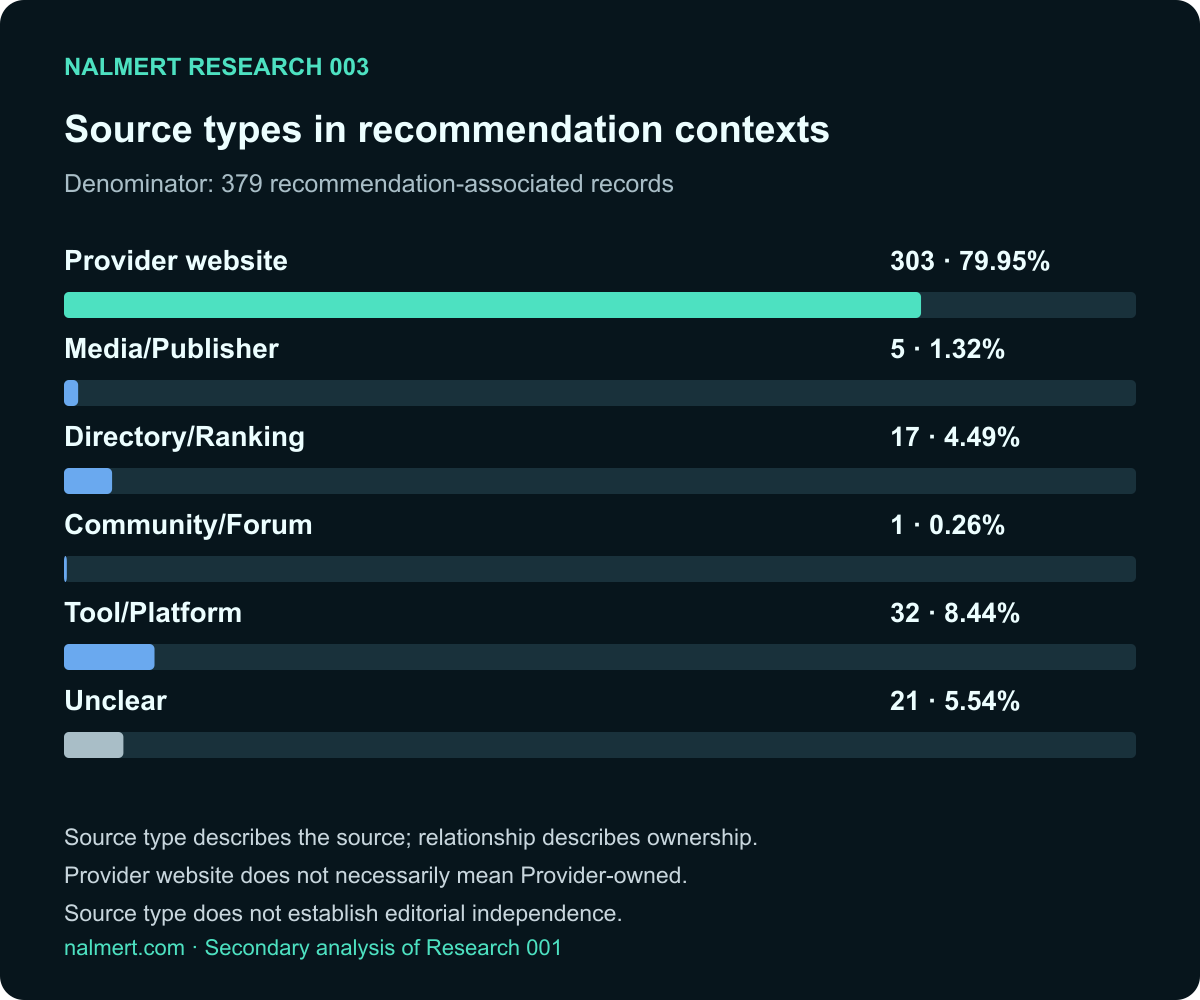
| Source type | Count | Share |
|---|---|---|
| Provider website | 303 | 79.95% |
| Media/ | 5 | 1.32% |
| Directory/ | 17 | 4.49% |
| Community/ | 1 | 0.26% |
| Tool/ | 32 | 8.44% |
| Unclear | 21 | 5.54% |
| Total | 379 | 100% |
Research/Academic, Government/Institutional, Marketplace and Other had zero records in this recommendation-associated source-type subset. Individual rounded percentages can sum to slightly above or below 100%.
Why domain-level classification is insufficient
The audit identified 28 citation rows with both owned and third-party relationships. Separately, 34 domains had both relationship roles across their association contexts. These are different aggregation levels: 28 rows and 34 domains are not counts of the same objects.
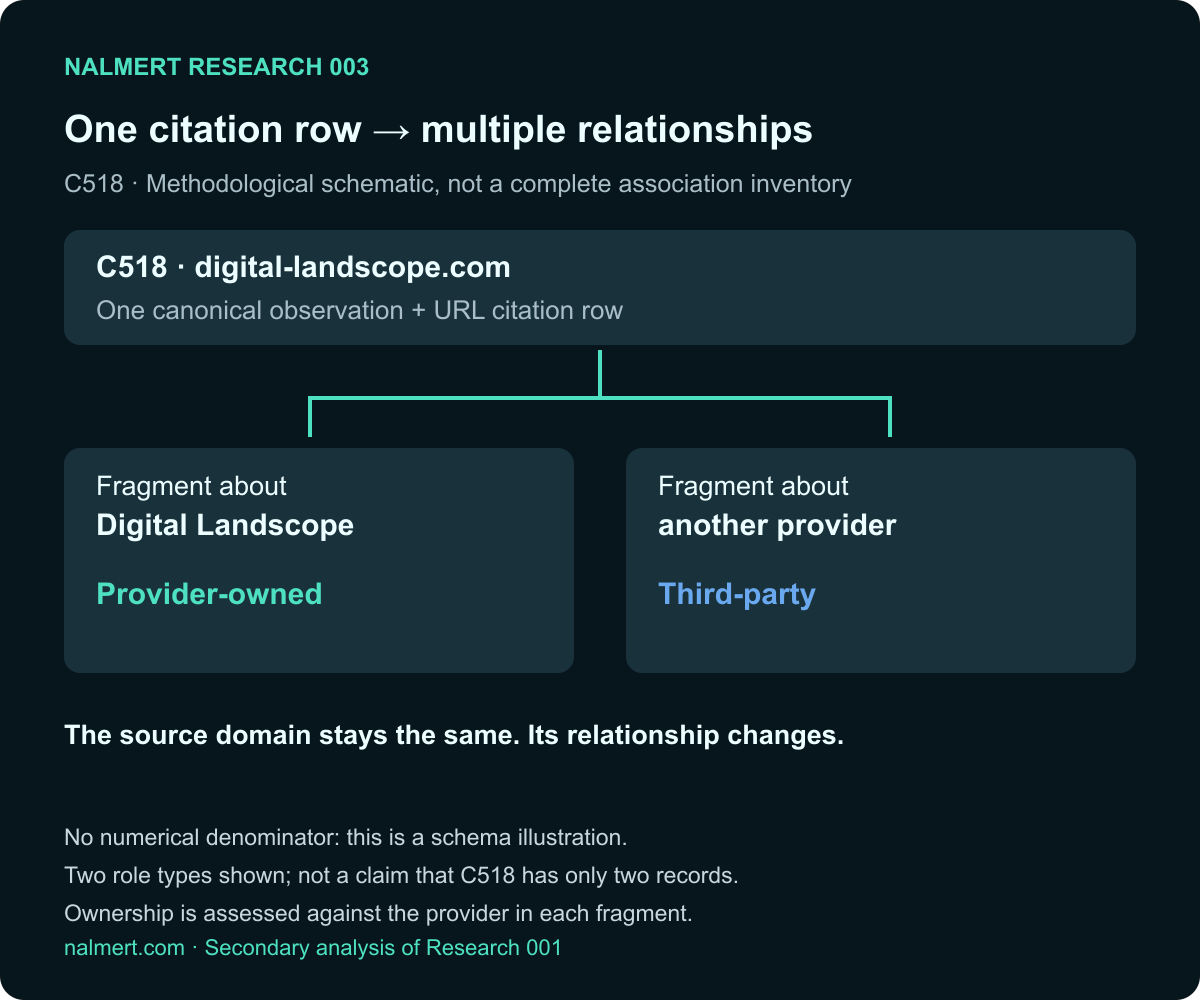
C518 illustrates the problem: a digital-landscope.com citation can have a Provider-owned association for Digital Landscope and Third-party associations when supporting fragments concern other providers. The website does not change, but the relationship does. The SeoProfy cases C158 and C574 and the GrowPad C537 case likewise show why the surrounding observation and cited page must be checked rather than assigning every row a role from its domain name.
Third-party does not mean independent editorial endorsement
Editorial independence was recorded separately and was unknown for 1,174 of all 1,193 annotation records. There were 0 records confirmed as Independent editorial, 1 Syndicated press release, 10 Provider-authored, and 8 Platform/documentation records. User-generated/community had 0 confirmed records in this editorial-independence field. These counts describe all annotation records, not just the recommendation-associated subset.
Zero confirmed Independent editorial records is a statement about what this evidence established, not proof that no independent editorial sources existed. A media-hosted press release remains a Media/Publisher source while its syndication status is recorded separately. The 102 Third-party recommendation-associated records must not be presented as 102 independent editorial endorsements.
Methodology: reconstruct the link, then classify it
The canonical dataset remains 578 observation–URL citation rows. The association layer is a separate analytical layer; canonical citations, original AI observations and Research 001 were not rewritten.
- Locate the citation row in its original observation and identify the visible cited URL.
- Use an exact supporting textual span or reference to connect the citation to a provider. Do not reconstruct hidden “+N” sources, grouped markers or missing response fragments.
- Record Mention and Explicit Recommendation separately. Explicit Recommendation requires affirmative evidence and implies Mention; a list position or a source-page headline alone is not sufficient.
- Assess ownership against the provider in that fragment: Provider-owned, Third-party, General supporting source, or Unclear. Do not label a commercial domain Provider-owned merely because it is a company website.
- Record source type, editorial independence, confidence and the evidence note separately. Leave provider_entity_id null where no approved entity ID exists.
- Check exact-span matches, citation URL consistency, allowed taxonomy values, unique association IDs, unique citation-row × fragment × provider combinations, and Recommendation ⇒ Mention.
Unclear is retained whenever evidence cannot support a relationship. It is not a residual category that must be reduced to improve a finding. Annotation exports were checked for totals and JSON/CSV roundtrip consistency. See the broader Nalmert measurement methodology for the distinction between observations and measured signals.
Which records are excluded from the primary denominator?
The 72 general supporting records cannot be assigned to a particular provider recommendation. The 370 unresolved records without a confirmed provider association also do not qualify. Other provider-associated records lacking explicit recommendation evidence remain outside the 379-record primary set. In contrast, the 21 primary records with an Unclear ownership relationship remain in its denominator because their recommendation-associated context was reconstructed even though ownership remained unresolved.
Read 256/379 as an association-level result. Dividing by 578 citation rows or 1,193 annotation records would answer a different question. Several associations may come from the same citation row or AI answer; they are not independent statistical trials.
Limitations
- This is a secondary analysis of the same Research 001 observations, not an independent replication or a new AI measurement.
- Associations within one answer are dependent. Provider and category representation is uneven; counts are not market-share estimates.
- Only visible citation evidence and reconstructable fragments are analyzed. Missing or grouped evidence was not invented.
- The primary subset contains 21 unresolved ownership relationships. A further 370 annotation records without a confirmed provider association are excluded from it.
- Source type, ownership and editorial independence answer different questions. Third-party does not establish independent editorial endorsement.
- Percentages are descriptive. No independent-trial confidence interval or significance claim is made for these clustered association records.
- The audit supports no causal inference and no claim about trust or preference. It does not show that publishing owned content causes AI recommendations or improves search rankings.
What the evidence supports
Provider-owned relationships were more common than third-party relationships in the reconstructed recommendation-associated subset: 256 versus 102 records, with 21 unresolved. A single citation domain can serve owned and third-party roles in different contexts. Citation analysis of AI recommendations therefore needs an association-level relationship layer, not a domain-only ownership label.
The 67.55% result applies only to the 379 reconstructed recommendation-associated records—not to all AI citations. This is an audit of citation relationships, not a ranking of providers or a prescription for SEO/GEO tactics.
Research provenance and author
Nalmert Research 003 uses the existing Research 001 study and its canonical citation evidence. Author: Alexander Tatyanchenko, Founder of Nalmert.